

Just over seventeen hundred years ago, the slow death of Christianity began with the First Council at Nicaea. The dynamic teachings of Christ Jesus that generated observable changes in his disciples was replaced by a political institution that inserted itself between God’s prodigal children and their Divine Father. Unlike his pagan predecessors or worldly Jewish sects, Christ Jesus showed the way for every individual to establish an intimate relationship with God. A direct relationship with God comes with incredible power. The initial power of self-control and positive behavior is followed by greater expressions of uncommon material phenomena.
The early martyrs displayed phenomenal powers. The Romans had little interest in executing children or adults who posed no threat. However, many early disciples of Christ expressed abilities of healing and casting demons out of the possessed. Their abilities were talked about across the Empire. Physical healing may seem helpful and desirable but when the emperor cannot perform similar feats, those who could became a threat to his power. For several generations, the underground religion grew based on observed powers of Christ’s disciples as well as rumors about the exceptional benefits of discipleship. Standing orders allowed the regional authorities to execute Christians. For early martyrs, evidence of the benefits of belief in the crucified Jewish King, overruled the fear of execution.
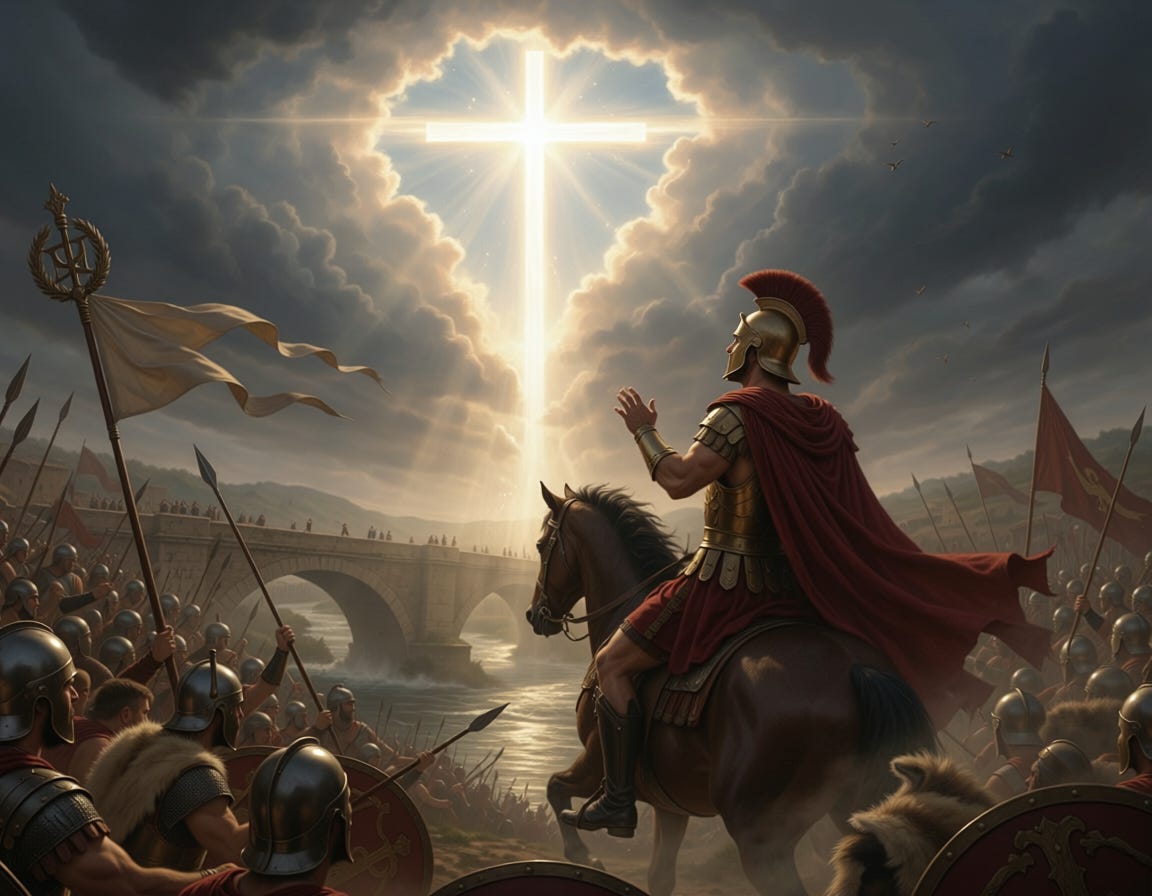
The Roman Emperor Constantine I claimed to have had a vision of the cross of Christ Jesus during the battle at Milvian Bridge in 312 CE. He credited winning that battle to endorsement by Christ. Constantine made a mental bargain with this culturally subversive god. Constantine recognized Christ’s teachings as an official religion in exchange for the win. Milvian Bridge stopped the progress by Constantine’s chief competitor Maxentius for the consolidated rule over the Western and Eastern Roman territories.
Comparisons to Saul’s conversion (to the Apostle Paul) on the road to Damascus were spread across Christian churches. A history of the miraculous conversion of Constantine I at Milvian Bridge to Christ was promoted. A few years passed and Constantine witnessed the power that resonated throughout the common population from the story of Christ’s endorsement. Like Paul, Constantine claimed a true conversion. Unlike Paul, the Emperor did not display any phenomenal powers. False rumors were spread about the emperor’s powers, but no one witnessed evidence of a change in Constantine. The fruit of the Spirit did not mature in the Roman Emperor. A decade passed before he called together a gathering of three hundred and fourteen known Christian Bishops to discuss the tenants of the faith and to formalize the religion for official status in the Empire.
Critical thinkers and historians with common sense have a less than miraculous view of the events that led to institutional Christianity. In 312 AD Constantine was having difficulty keeping the Roman Empire together. The farthest reaches returned to self-rule and invaders threatened the Northeast border. Before the Battle at Milvian Bridge another self-proclaimed Emperor, Maxentius, ruled the Eastern provinces. His capital in Constantinople was a direct affront to Constantine I’s power center in Rome.
As the average Roman citizen became increasingly self-centered, the pagan gods of their ancestors became less powerful and unimportant to daily living. Perhaps, the decline of the pagan gods can be attributed to an individual lack of interest. Perhaps, the leaders stopped their public worship. Either way, the result was a slow denigration of social order.
As worshipful beings, humans were intrigued by the steady growth of the disciples of Jesus. The persecuted religion was discussed within households across every Roman territory in both the East and West. The discussions also infiltrated Constantine’s home life. His mother Helena had converted to Christianity. In addition, Christianity spread beyond the official borders of the Empire. For example, the faith grew quickly in distant areas of the Middle East and Africa.
For any Roman Emperor, the fall of paganism disabled one of their primary propaganda tools. The blessings and support of the gods was essential to maintaining an effective rule. The now powerless pagan gods who lacked far-reaching respect were not helpful in swaying the general population to comply with official edicts. Without a divine endorsement, an emperor was just another man in pursuit of selfish goals.
There were small sects of unofficial pagan religions within the Roman Empire, and practitioners who worshipped their local historical gods. However, the largest organized, public group was the Jewish population. Judaism held an uncomfortable position within the empire. A demanding thorn in the side of every political administration, Jewish authorities tried to exert maximum influence with minimal investment in provincial infrastructure, political aims and military campaigns.
An adept and transformational politician, Constantine identified a risky opportunity to reenergize his power and to potentially extend his influence beyond current Roman borders. With his win at the Battle of Milvian Bridge, Constantine decided to acknowledge, formalize and officially endorse the Christian faith. His mother, Helena, would be happy. The power of Jewish authorities would decrease. The difficulties associated with persecuting adherents to the growing faith would be resolved. Most importantly the Eastern and Western divisions of the Empire would be united in spirit if not yet joined in political intentions. The convenient win at Milvian Bridge provided a miraculous opportunity to turn the tide of political power in his favor. Whether or not Emperor Constantine experienced anything supernatural was insignificant, this was an opportunity to solidify his rule.
Christianity before Nicaea was a dynamic religion. As a persecuted faith, those who adhered to the ideal commandments of Christ had no hesitation to completely commit. Disciples potentially faced martyrdom for their faith. Individuals were not going to settle for the sermons and beliefs promoted by local leadership without signs and wonders. Even the miracle-working antichrists of the first generations were often dethroned when their deceit was revealed. Though the early priests, bishops and deacons were mostly self-appointed, they were known for their love, peace, joy, wisdom and self-control. The best of the leaders may have been acknowledged as someone who studied directly under an Apostle. Early Christian communities became known for their love, rather than for official titles conferred by an authority. Mutual respect was more common than hierarchical authority. Eary Christians spread the teachings in-person, verbally, to a largely illiterate population. Every group and region had religious leaders who manifested the fruit of Spirit and uncommon phenomenal powers described in the highly coveted and secretly protected scriptures.
While the teachings of Christ Jesus cannot be stopped, the good intentions of those who clamored to establish the official faith back in 325 CE ensured a degradation of the teachings. Council decisions had the authority of Roman law behind them. The leaders turned away from common languages of Greek, Hebrew and Aramaic to adopt the official language of the Roman elite (Latin). The hallmark “do something to get something” negotiations of worldly administrations began with an insistence that followers affirm the official creed.
Subsequent persecutions of those who wanted to continue healthy debate regarding Jesus resulted in oppression of sincere disciples who rejected consolidated human authority. As the years passed, Emperor Constantine desired to reunite the Eastern and Western divisions of the Roman Empire. To escape the hidebound, hereditary political families in Rome, Constantine moved his capital to Constantinople. When the Christian Bishops of the Roman Church refused to follow him, he simply established a new church which became the basis for the Eastern Orthodox Christian religion.
Political power and the associated accumulation of wealth is nearly impossible to end once it has begun. Soon Christian authorities in both Rome and Constantinople anointed the emperor, approved marriages between important political leaders and endorsed wars to be conducted in the name of the Prince of Peace. Endless intellectual theological debates led to sense-bound rituals and solutions, all with the force of a militant government behind them. Eventually, when the leaders of the Roman Catholic Church refused calls for reform from within, such as those from Martin Luther, the Reformation of human-centered institutional Christianity began. For a brief period, Christians were once again willing to lay down their lives in the hope of experiencing a direct relationship with God through the grace of Christ Jesus. This willingness to die for their beliefs led to countless Protestant divisions.
As these divisions rose to regional power, and the death-threat cost of discipleship decreased, yet another institutional Christianity without Christ Jesus arose. The Anglo-Saxon King Henry VIII grew tired of Rome’s judgment of his immoral behaviors and took the radical step of establishing a new religion with his throne at the head. Like Constantine in the past who established Christian religions based in his capital cities of Rome and Constantinople, King Henry VIII established a religion. The King had no issue with the conduct expected of his subjects under the existing Roman Catholic church structure, but wanted his own life above judgment and his power to carry the divine mystery.
Without centralized control and void of disciples who were apparent by the depth of supernal love, subsequent modern Protestants have endorsed all manner of sensual-led lifestyles in the name of Christ. The current state of turmoil within Christianity at large can be traced back to those first decisions in Nicaea that established the faith as a formal political institution.
By God’s mercy, the Bible has survived millennia relatively intact. In most translations, it is possible to discover and elaborate on the commandments of Christ. While Jesus simplified some of the laws of the Jewish people, he kept most of their practices. An attentive prayer life that includes multiple times each day to stop and reflect. A level of devotion that produces concentration and inner stillness. The sincere desire to crucify the flesh with its passions and desires. During the current realignment of Christianity in a move away from institutional religions, it’s important not to sacrifice the original tenants commanded by Christ. Look for the results in today’s disciples who display the fruit of the Spirit and phenomenal powers. Take the opportunity to learn from each other.
Any successful Christian today or across any century of time displays the common fruit of discipleship elaborated by Paul in Galatians 5:22-5:23. These include:
Love, joy, peace, patience, kindness, goodness, faithfulness, gentleness, and self-control.
It is nearly impossible to find disciples who exhibit the uncommon powers that appear in those who have established stable relationships with Christ Jesus. These include:
From Christ’s own words, Mark 16:17-16:18
The signs that accompany disciples –
they will cast out demons;
they will speak in new languages;
they will pick up serpents with their hands.
If a disciple drinks any deadly poison, it will not hurt him.
When a disciple lays their hands on the sick, the sick will recover.
Paul has documented additional powers and limitations of disciples. In 1 Corinthians 12 he explains that a disciple who is in the Spirit of God never states that “Jesus is accursed” nor can one who is not in the Spirit of God have any power simply by stating “Jesus is Lord.” (12:3);
Some have intuitive wisdom while others obtain intellectual knowledge (12:8);
Some have persevering faith and another displays the gift of healing (12:9);
Other disciples work miracles (uncommon, phenomenal displays), give prophecy, distinguish between spirits, and there are those who speak and interpret various languages (12:20).
Not only was the expectation of the personal responsibility to cultivate a direct relationship between the disciple and God lost, the First Council of Nicaea created a world-bound institution and called it the body of Christ. Some have argued that the formation of a politically motivated church preserved the scriptures and the gospel story for posterity. The critical thinker looks to common sense to see the rise of superficial discipleship based on obedience to the worldly aims of men guided by the Liar. The loss of enlightening debates that led to permanent improvements in a disciple’s behavior is apparent in the lack of the signs and wonders displayed by disciples.
Paul summarized the issues regarding the members of the body of Christ in 1 Corinthians 12:27-12:31, he stated:
Disciples are the body of Christ and individually members of it. God has appointed some and endowed them with notable powers. First the apostles, second prophets, third teachers, then those who display miraculous gifts of healing, helping, administrating, and various kinds of languages. Though not all are apostles, or prophets, or teachers, or miracle workers, or those who possess gifts of healing or speaking and interpreting languages, all should earnestly desire the higher gifts.
Paul promised the Corinthians that “I will show you a higher way.”.
The primary requirement to be a Christian is to have a life-transforming relationship with Christ. Christ is sufficient.
Before the First Council at Nicaea, the higher way of Christ Jesus was communicated face-to-face. There was a in-person transmission of love as well as baptism in the Holy Ghost for those who were ready for more than the water-based ritual of repentance.
At the First Council of Nicaea, the bishops in attendance traded eternal life in Christ for the death found in political power. As a group, they had good intentions to formalize the teachings of Christ Jesus. Unaware of the adage, “the way to hell is paved with good intentions”, the bishops in attendance were evenly divided between whether Jesus was a leading prophet like Moses, or the actual Son of God. Because all of them had not experienced Christ directly, they fought over an accurate creed for the official faith. These formative bishops were not united. The end of healthy debate illustrated a failure to recognize that the strongest relationships with God are personal and born in hardship. Christ offers a new creation.
A church based on political power can only hope to be as effective as the government to which it has been hitched. With the establishment of a formal structure, the Roman Church administration now chose the winners and losers across followers. The focus on lists of harmful “beliefs” and required affirmation of worldly creeds continues today.
Discipleship is extremely personal and intimate. As each child aligns with the parents in a myriad ways, each of Christ’s disciples finds unique and unexpected qualities in their relationship with Jesus. Discipleship with Christ Jesus requires one be ready to “die” to their worldly attachments to surrender to the discipline of a better life as a child of God.
At the first Council of Nicaea, Christians lost the expectation of the essential requirement of embracing Christ directly. The intimate relationship, though still available to those who persevere, became overshadowed by the sense-bound rituals of a political institution called “church”.